Crossing a Split in Reference Copper
An analysis of what happens when high-speed traces cross a gap in reference copper that extends to the board edge.
7/14/2026
Splitting reference planes is a fast-track to a failed EMC test.
A recent evaluation of a dual BLDC motor controller layout reveals a critical EMC and signal integrity flaw: routing fast-edge PWM and sensitive analog measurement signals directly across a split in the adjacent reference copper (and of course the lack of a continuous reference plane).
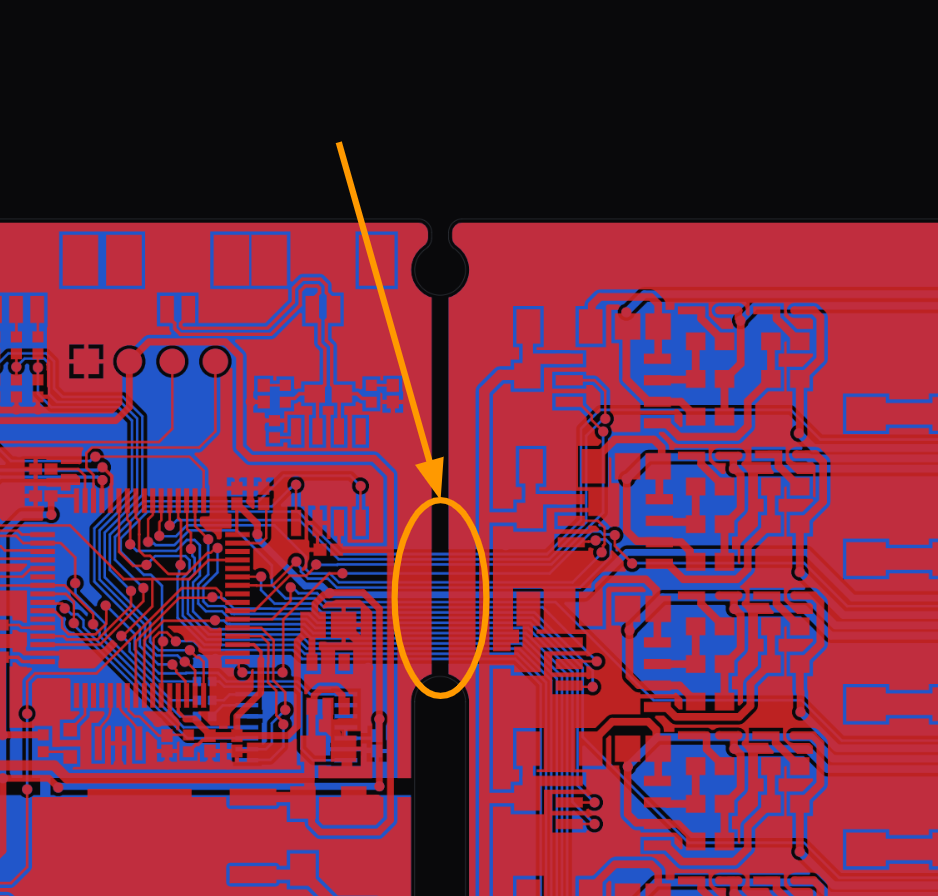
Here’s the physics of why crossing this gap fails:
• Radiated Emissions & Edge Radiation: With fast edge rates and sensitive analog, these signals must be routed like transmission lines. Crossing a gap in the reference leaves the energy unbounded and uncontrolled. This converts switching transients into radiated emissions. Because this split extends to the board edge, the unbound energy leaks directly into free space, spiking emissions.
• Crosstalk & Common-Impedance Coupling: Routing sensitive analog and PWM signals across this gap forces both return currents to share a high-impedance detour. This common-impedance coupling introduces noise into the analog signals, contaminating the information required for accurate motor control.
Recommended Layout Modifications:
• Utilize a Continuous Reference Plane: Avoid splitting ground planes to isolate circuits. Use a single continuous plane and enforce strict component partitioning to inherently prevent return current overlap.
• Never Route Across Gaps: If a split or gap is mandated by design constraints, strict routing discipline must ensure no traces ever cross the void on an adjacent layer.
• Route the Return: If continuous return planes aren’t possible in the application, route critical signals across any gaps as a triplet with a dedicated coplanar return trace at minimum spacing to tightly bound the electromagnetic field. Make sure both sides of the return trace are attached to the reference plane with vias.
Need this level of analysis for your next board?
Get in touch with our experts to book a consultation.