Using Stitching Vias at Layer Transitions in SGGG Boards
Stitching vias are an incredibly useful tool when managing fields at layer transitions in PCBs.
5/26/2026
Routing a high-speed signal from the top to the bottom layer of a four-layer board can quickly become an EMC risk if not done correctly. While the conduction current easily travels through the copper via, the actual energy in the electromagnetic field can become unbounded if the transition is not explicitly engineered.
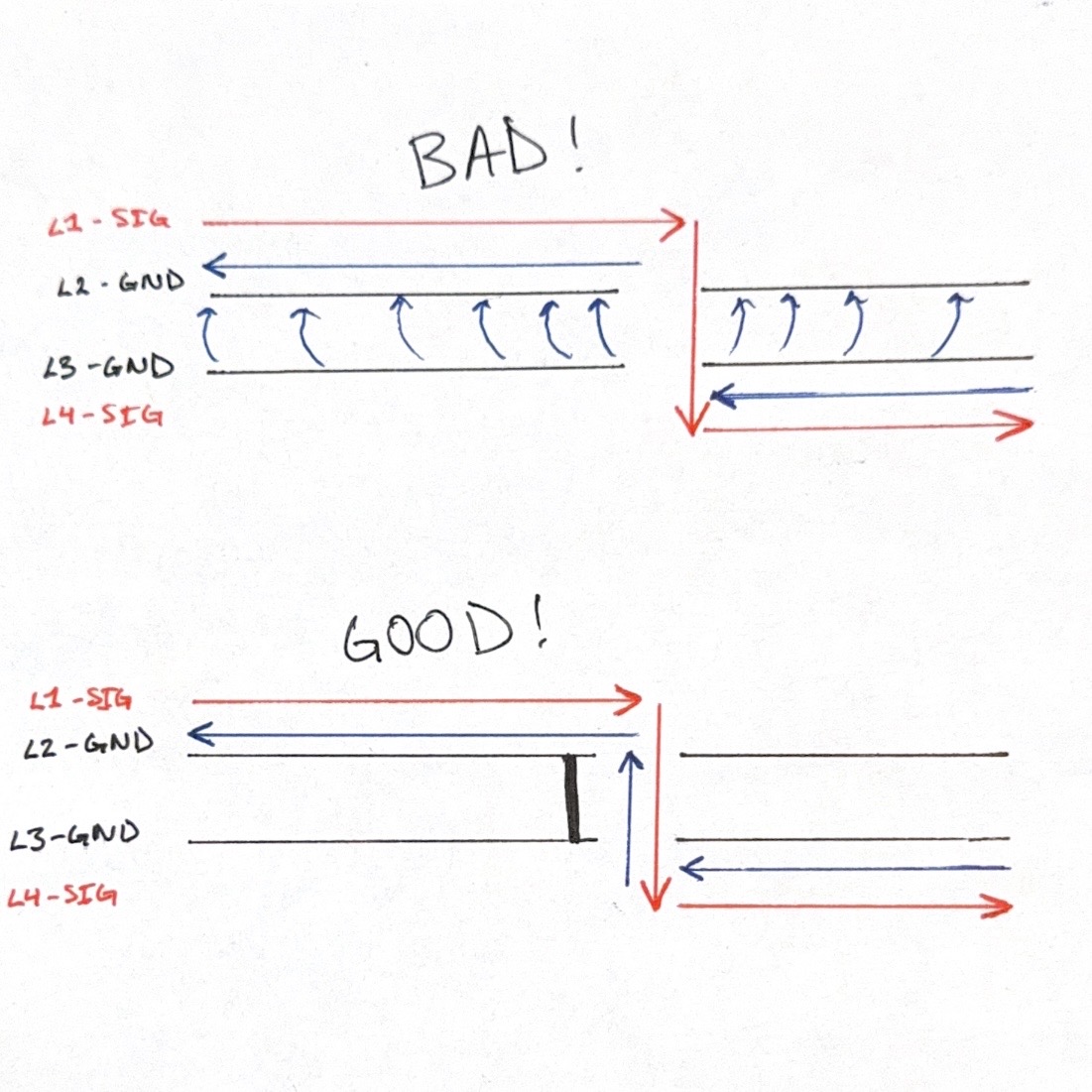
Here is the physics of why stitching vias are critical when changing routing layers:
• Dielectric Transition: Signal energy does not travel in the copper; it travels as an electromagnetic wave in the dielectric space between the trace and its reference plane. When a signal moves through a via to a new routing layer, its electromagnetic field must also transition to the new dielectric space.
• Unbounded Field Spread: If the two reference planes are not properly bridged at the layer transition, the displacement return current loses its defined path back to the source. Without a defined path, the electromagnetic field leaks and spreads throughout the dielectric between the two planes.
• Crosstalk and Radiation: As these fields spread outward they cross-couple into dozens of other unrelated vias occupying that same area, generating crosstalk and board-edge radiation.
• Bounding the Field: Placing a ground stitching via immediately adjacent to the signal via creates a localized, low-impedance return path for the current. This tightly contains the electromagnetic field within the small physical space between the two via structures, preventing the field from spreading.
For robust EMC design, you cannot simply change routing layers and ignore the fields. Every layer transition must include an immediately adjacent return path to properly contain the electromagnetic energy.
P.S. This assumes layers 2 and 3 are both the same potential. If Layer 3 is a power plane instead, a stitching capacitor should be used to provide a path for the high-frequency current.
Need this level of analysis for your next board?
Get in touch with our experts to book a consultation.